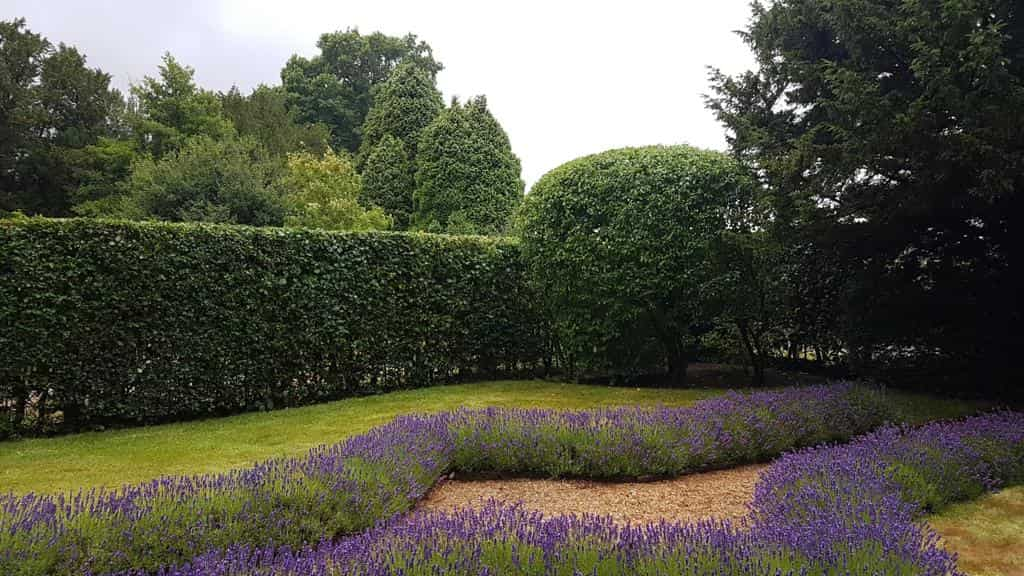
A mature hedge can be extremely valuable when it provides privacy around a garden, but that same hedge can eventually become difficult to accommodate. Years of growth may leave it excessively wide, unusually tall or extending into areas that were previously open and usable. Paths become narrower, borders disappear beneath foliage, and a substantial proportion of the garden can gradually be occupied by the hedge.
The obvious solution may seem to be cutting it back heavily. However, if privacy is one of the hedge’s main purposes, an overly aggressive reduction can create a different problem by leaving thin growth, visible gaps or an unattractive boundary.
For homeowners in Red Lodge, Suffolk, the answer is often to find a balance between controlling the hedge and retaining enough healthy growth to continue providing screening. Professional hedge cutting can help achieve this, but the appropriate amount of reduction depends on the hedge species, its condition, how far it has outgrown its intended boundary and how it is likely to respond to pruning.
How Can an Overgrown Hedge Be Reduced Without Losing Its Privacy?
An established hedge should not automatically be cut back to the smallest possible dimensions. If screening is important, the objective is usually to recover useful garden space while retaining sufficient height and density to form an effective boundary.
A professional assessment can consider:
- How much width has developed over time
- Whether both sides require reduction
- The current height of the hedge
- Where healthy foliage is concentrated
- Whether the hedge is dense or becoming sparse
- How the particular hedge is likely to respond to cutting
- Whether paths, lawns or borders are being obstructed
- How much privacy needs to be retained
- Whether substantial reduction should be approached gradually
- What future maintenance will help retain the new dimensions
This allows the work to be based on the hedge itself rather than simply cutting everything back to a predetermined line.
Width Is Often the Main Reason a Hedge Takes Over a Garden
An overgrown hedge does not necessarily need to be dramatically tall to dominate an outdoor space.
Width can be equally important.
If a hedge extends further into the garden each year, the loss of space may happen so gradually that it is barely noticed. Eventually, a hedge that once occupied a relatively narrow boundary can become a substantial feature.
Reducing excessive lateral growth can sometimes recover a surprising amount of usable space without significantly changing the screening provided by the upper part of the hedge.
This can be particularly useful where privacy is satisfactory but the hedge has simply become too bulky.
Privacy Does Not Necessarily Require Maximum Hedge Width
A very wide hedge is not automatically a more effective privacy screen.
Much of the excess growth may extend into the garden without providing a meaningful improvement in screening.
Where the hedge has a suitable internal structure and responds appropriately to pruning, reducing unnecessary width can produce a more defined boundary while retaining useful foliage.
The aim is to identify which growth is genuinely contributing to privacy and which has simply developed because routine cutting has not kept the hedge within suitable dimensions.
Professional hedge cutting can therefore be as much about restoring proportion as reducing overall size.
Cutting Back Too Far Can Affect the Finished Result
One of the main risks when reclaiming an overgrown hedge is attempting to recover too much space in a single operation.
The visible outer surface may contain most of the healthy foliage, while deeper sections contain older woody growth.
Cutting directly through the green outer layer can therefore produce a very different result from ordinary trimming.
Depending on the hedge, substantial reduction may expose bare or sparse sections that take time to improve, while some types of hedge respond less readily to cutting into older growth.
This is why the proposed reduction should take account of the individual hedge rather than assuming it can always be cut back to any desired size.
Different Hedge Species Respond Differently to Hard Pruning
Not every hedge should be managed in the same way.
Some types can tolerate substantial reduction relatively well, while others are less suitable for severe cutting into older growth.
This difference becomes particularly important when privacy needs to be retained.
An inappropriate cut may produce a boundary that is considerably thinner or less visually complete than expected.
Professional assessment can identify how the hedge is likely to respond and determine whether the desired reduction is realistic.
Where a dramatic change would compromise the hedge, a more measured approach may be preferable.
A Gradual Reduction Can Sometimes Be More Appropriate
An overgrown hedge does not always need to reach its final desired dimensions immediately.
Where substantial reduction is required, managing the hedge progressively can sometimes provide a better balance between recovering garden space and retaining screening.
The exact approach depends on the hedge.
For example, one section or dimension may be addressed first while other growth remains to provide privacy. Future maintenance can then continue moving the hedge towards more manageable proportions where appropriate.
This is not necessary in every situation, but it illustrates why substantial hedge work benefits from planning rather than indiscriminate cutting.
Height and Width Should Be Considered Separately
A hedge that is too large can have several different problems.
It may be too tall, too wide or both.
If privacy is the main benefit of the hedge, reducing its width may be more important than dramatically lowering its height. Conversely, an excessively tall hedge may dominate the garden even if its width is reasonably controlled.
Treating height and width as separate considerations allows the work to be more precise.
A hedge does not need to be reduced equally in every direction simply because it has become overgrown.
The Right Height Depends on What the Hedge Needs to Achieve
There is no single ideal hedge height for every garden.
The useful height depends partly on what needs to be screened and how the surrounding outdoor space is used.
Reducing a hedge too far may remove much of the privacy that made it valuable in the first place.
Leaving it unnecessarily tall, however, can make maintenance more difficult and allow it to remain disproportionately large.
The objective should be to retain enough height to perform the required screening function while bringing the hedge into better proportion with the garden.
Lower Growth Is Important for a Complete Privacy Screen
Privacy does not depend only on the top of the hedge.
A tall hedge that becomes thin or open near its base may provide less effective screening than a slightly lower hedge with dense growth from top to bottom.
When planning hedge cutting, the overall condition of the boundary should therefore be considered.
Repeatedly allowing the top to become excessively large while lower areas deteriorate is not necessarily the best long-term management approach.
Maintaining balanced growth can help the hedge remain visually substantial without allowing individual sections to dominate.
Overgrown Hedges Can Narrow Paths
Paths running alongside hedges are particularly vulnerable to gradual encroachment.
New shoots extend over the edge, and repeated growth can eventually make the path noticeably narrower.
This can make routine access inconvenient and give the garden a cramped appearance.
Targeted hedge cutting can restore a clearer edge and recover the intended width of the path.
Where privacy is provided mainly by growth above this level, it may be possible to improve access without substantially affecting the hedge’s screening function.
Driveway and Entrance Clearance Can Also Be Restored
A hedge near an entrance can become inconvenient when growth extends into the available access space.
The solution does not necessarily require removing or severely reducing the entire hedge.
Targeted cutting can focus on the sections responsible for the encroachment.
The rest of the boundary can then retain its established screening.
This type of selective management is often more useful than treating the hedge as one uniform block that must be reduced equally everywhere.
Garden Borders Can Disappear Beneath Overgrown Hedges
Established hedges can gradually spread over planting areas.
As the outer growth extends, borders may become narrower and nearby plants can be increasingly overshadowed.
Reducing the hedge to a more suitable line can help restore separation between the boundary and the rest of the garden.
The amount of space that can realistically be recovered depends on how far the hedge can be cut while retaining appropriate growth.
This is another reason to assess the internal condition of the hedge before deciding on the final dimensions.
More Light May Be a Secondary Benefit
Large hedges can influence the amount of light reaching nearby parts of a garden.
Reducing excessive height or width may allow more light into surrounding areas, depending on the position of the hedge.
However, hedge cutting should not be approached with the assumption that maximum reduction is always desirable.
If privacy remains a priority, the goal may be to achieve a reasonable improvement in openness while retaining sufficient screening.
Balancing these objectives usually produces a more useful result than focusing entirely on one of them.
An Uneven Hedge May Need More Than a Quick Trim
Long-neglected hedges often develop irregular shapes.
Some sections may extend considerably further than others, while the top can become inconsistent and difficult to maintain.
A light trim follows the existing outline and may therefore make the hedge neater without genuinely correcting its proportions.
More considered cutting can establish a clearer line and address excessive growth where the hedge can tolerate it.
The distinction between trimming and reduction is important when a hedge has substantially outgrown the space available.
Trimming and Hedge Reduction Are Not the Same
Routine trimming primarily controls recent growth and maintains an established shape.
Hedge reduction is more substantial.
It becomes relevant when the hedge’s existing dimensions are themselves the problem.
If a hedge already extends far into the garden, simply removing the latest shoots will leave most of that unwanted width intact.
A reduction aims to establish more suitable dimensions, after which routine cutting can help maintain them.
Understanding this difference can prevent years of trimming a hedge that remains fundamentally too large.
Regular Cutting Can Help Prevent the Problem Returning
Once an overgrown hedge has been brought into more manageable proportions, future maintenance becomes important.
Allowing substantial amounts of new growth to develop repeatedly can gradually recreate the same problem.
Regular cutting helps maintain a defined boundary by controlling new growth before it becomes established.
This can also make future work more straightforward because maintenance focuses on relatively recent growth rather than repeatedly requiring substantial reductions into older parts of the hedge.
The appropriate frequency depends on how the individual hedge grows rather than an arbitrary schedule.
A Defined Hedge Line Makes Maintenance Easier
One advantage of professional hedge cutting is the opportunity to establish a clear shape that can be maintained in the future.
Without a defined line, small amounts of additional width can be left after each cut.
Over many years, this can result in the hedge gradually expanding despite receiving regular attention.
Establishing appropriate dimensions provides a clearer reference point for future maintenance.
This helps prevent gradual encroachment and makes it easier to preserve both usable garden space and the hedge’s screening function.
Heavy Cutting Is Not Always the Best Way to Reduce Future Maintenance
It may seem logical that cutting a hedge back as severely as possible will mean it needs less attention later.
This is not necessarily the case.
The hedge’s response depends on its type, condition and the extent of pruning. Severe cutting can sometimes produce an unsatisfactory appearance or vigorous new growth.
A more appropriate objective is to establish dimensions that can be maintained reasonably without unnecessarily compromising the hedge.
Good hedge management is therefore about control rather than simply removing the maximum possible amount of growth.
Complete Removal Is Not the Only Option for an Oversized Hedge
A hedge that occupies too much space can make removal seem like the simplest solution.
However, removing an established hedge also removes the privacy it provides.
Where the hedge remains suitable for retention, professional reduction can often be explored first.
The important question is whether enough size can be removed to make a meaningful difference while preserving appropriate growth.
If this balance can be achieved, the garden can regain useful space without sacrificing the entire boundary feature.
The Existing Condition of the Hedge Matters
Before substantial cutting is planned, the hedge’s current condition should be considered.
A dense, healthy hedge may offer different options from one that is already sparse or uneven.
Existing gaps, previous pruning and the amount of healthy outer foliage can all influence the likely result.
This assessment helps set realistic expectations.
Tree surgery and hedge cutting should respond to what is actually present rather than assuming every overgrown hedge can be reshaped in exactly the same way.
Professional Hedge Cutting Can Balance Several Objectives
Homeowners rarely have only one objective when dealing with an overgrown hedge.
They may want more garden space, clearer paths, improved light, a neater appearance and continued privacy at the same time.
These requirements can sometimes compete with one another.
Professional hedge cutting allows them to be considered together.
Rather than simply making the hedge as small as possible, the work can focus on achieving useful dimensions while retaining the characteristics that make the hedge valuable.
Planning the Finished Size Before Cutting Matters
Substantial hedge reduction should begin with an idea of what the finished boundary needs to achieve.
How much space needs to be recovered? Which parts of the hedge provide important screening? Is excessive width the main concern, or does the height also need attention?
Answering these questions helps determine where reduction will provide the greatest benefit.
It also avoids unnecessary cutting in sections that are already performing appropriately.
A planned approach can therefore produce a more practical result than treating every part of an established hedge identically.
Hedge Cutting in Red Lodge, Suffolk
For property owners in Red Lodge, Suffolk, an overgrown hedge does not necessarily mean choosing between garden space and privacy.
At Red Lodge Tree Surgeons, we can assess the hedge’s current dimensions, condition and growth before determining how much reduction may be appropriate.
Where excessive width can be reduced while retaining useful screening, work can focus on reclaiming space and creating a more manageable boundary. Where heavier cutting could compromise the hedge, a more measured approach can be considered.
The aim is to manage the hedge according to what the garden actually needs while retaining its value as an established privacy feature wherever appropriate.
Conclusion
Yes, it is often possible to reduce an overgrown hedge while retaining useful privacy, but the correct approach depends on the hedge itself.
Excessive width can frequently be addressed without removing all of the height or density that provides screening. However, cutting too deeply into an established hedge can produce sparse areas, and different hedge types vary in how well they respond to substantial reduction.
The best approach is therefore to decide what space needs to be recovered, assess how much healthy growth can appropriately be removed and establish dimensions that can be maintained more easily in the future.
If your hedge has become too large for your garden in Red Lodge, Suffolk, but you would still like to retain its privacy benefits, contact Red Lodge Tree Surgeons. We can assess the existing hedge and recommend an appropriate cutting approach based on its condition, dimensions and the screening you want to preserve.
Call us on:01638 591 675
Click here to find out more about Red Lodge Tree Surgeons
Click here to complete our contact form and see how we can help with your tree care needs.